
A short introduction to operating systems (2001)
Livro digital
Título:
A short introduction to operating systems (2001)
Autor:
Mark Burgess
Categoria:
Tecnologia > DevOps
Doador:
Raffaello D. N.
Sinopse:
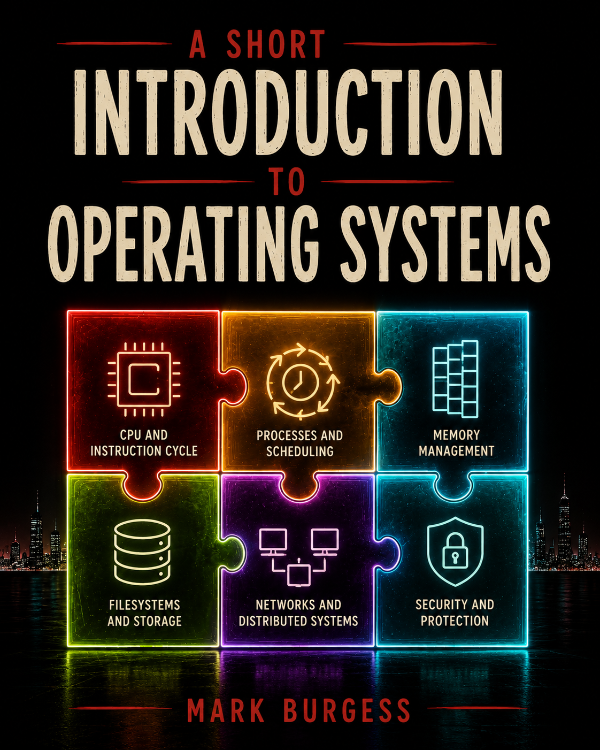
What actually happens between the moment you press a key and the character appearing on screen? Mark Burgess unpacks the invisible machinery of computing by building understanding from first principles: the CPU's instruction cycle, interrupt handling, memory addressing, and the layered abstractions that turn bare silicon into a responsive, multi-user environment. Starting with single-task systems—memory maps, stacks, and buffered I/O—and progressing to multi-tasking kernels, the book traces how operating systems evolved to share finite resources among competing users and processes without collapse.
The journey moves through the core pillars of OS design: process creation and scheduling (fork, wait, context switching), thread models from POSIX pthreads to Solaris LWPs, and the delicate dance of synchronization—mutexes, semaphores, critical sections—culminating in deadlock detection and recovery. Memory management receives meticulous treatment, from physical address binding and segmentation to paging algorithms, demand paging, and the notorious Tetris analogy for reclaiming fragmented memory. Disk scheduling, filesystem internals including UFS, and network protocol stacks up through TCP/IP and distributed filesystems like NFS and AFS round out the technical survey, while a closing chapter on passwords, encryption, firewalls, and public-key infrastructure grounds the discussion in real-world security.
Written as university lecture notes refined over years of teaching, the text distills what thick reference tomes expand into hundreds of extra pages. Each chapter closes with exercises and projects that transform passive reading into active problem-solving—a structure rare in introductory OS texts. Readers finish with a working mental model of the kernel's responsibilities, the ability to trace a system call through hardware and software layers, and a clear-eyed view of the trade-offs that shape every operating system decision.
Clique no botão abaixo para receber este livro.
Continue explorando
Livros disponíveis que combinam com esta leitura.
 Livro digital
  Livro digital
  Livro digital
  Livro digital
  Livro digital
  Livro digital